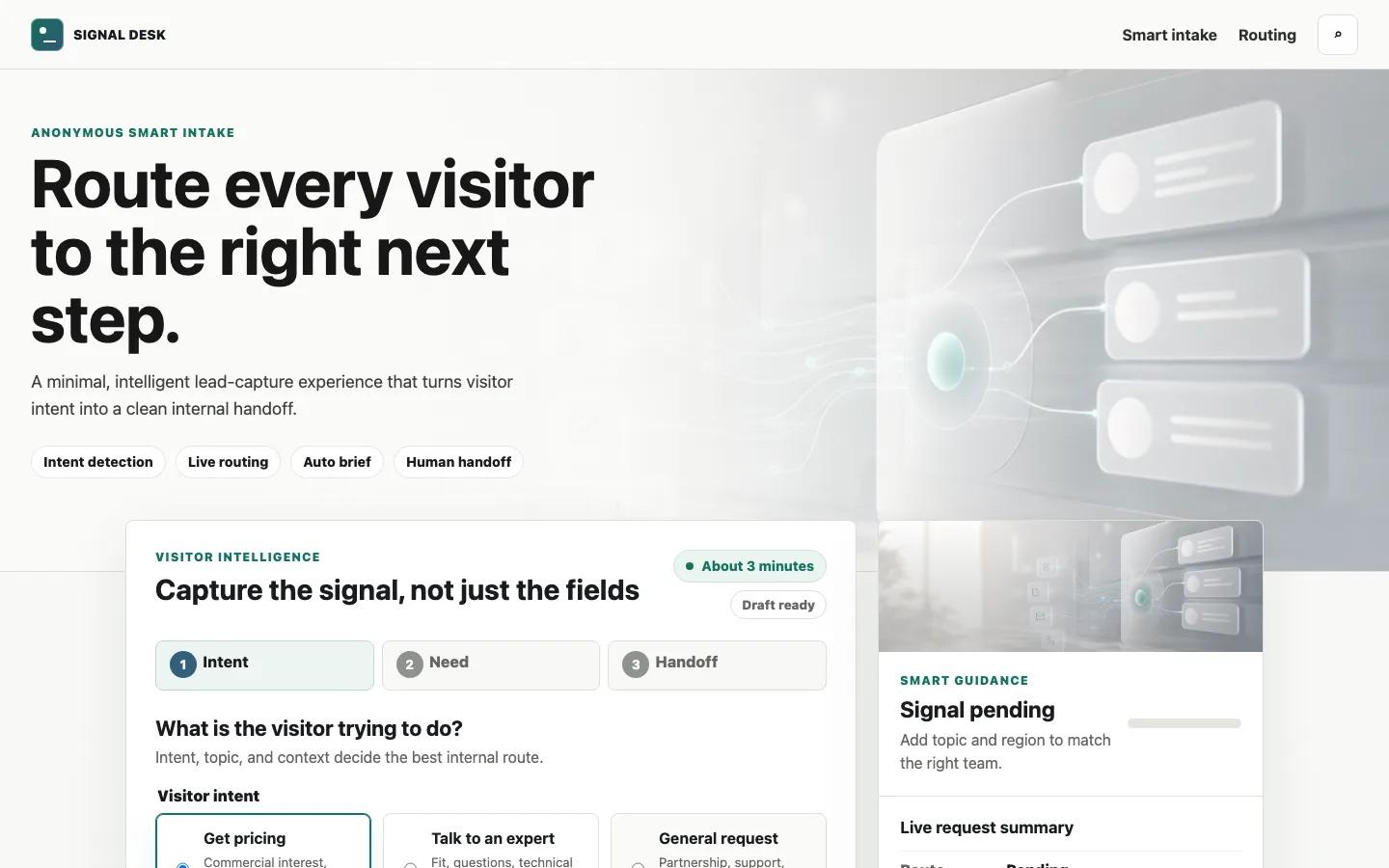
Route every serious inquiry with the context needed to respond.
Signal Desk replaces the generic contact form with a short, adaptive intake that qualifies intent, region, urgency, role, and need, then prepares a clean handoff for the right team.
- For
- Industrial marketing, sales operations, service, partnerships, and implementation
- Decision
- Who should own this inquiry and what do they need to know?
- Output
- Routed request with intent, urgency, context, and next action
- Build status
- Working reference build — routing and consent require validation
Capture the signal, not just the fields.
Try a progressive intake that starts with intent, reveals only relevant questions, and builds a live request summary for the buyer and internal team.
Working reference build — production requires CRM, privacy, consent, and routing validation
Qualification should remove effort, not add it.
Most contact forms ask the same fields in the same order, then make an internal team interpret a vague message. Signal Desk starts with intent and asks only the questions that can change the route, response, or owner.
A low-effort path with useful ownership.
The visitor builds a useful request rather than filling a database. A live summary creates ownership without adding unnecessary fields.
- 01
Start with intent
Begin with pricing, expert guidance, support, partnership, or implementation rather than personal details.
- 02
Use smart defaults
Use page context and the first answer to preselect sensible defaults and reveal only relevant questions.
- 03
Show honest progress
Preserve answers, allow back navigation, and show progress from the visitor's first meaningful action.
- 04
Prepare the handoff
Create a readable summary with route, owner, urgency, context, and the buyer's own words.
What this build demonstrates—and what a client-specific pilot would validate.
Review the capability, then define the data, controls, integrations, owners, and acceptance criteria for a bounded pilot.
- -Progressive disclosure can reduce visible form effort while preserving useful qualification context.
- -A live request summary gives the visitor a tangible result before submission.
- -Routing quality depends on internal ownership and response process, not the form alone.
Production requires validated routing rules, CRM field mapping, consent and privacy language, spam controls, analytics, accessibility testing, and service-level ownership after submission.
- -A progressive intake form tailored to the buyer journey, offer, routing rules, and internal handoff process.
- -CRM-ready lead summaries with intent, topic, urgency, region, role, notes, and recommended next action.
- -A lightweight routing and review layer that supports sales, support, partnerships, or implementation teams without adding buyer effort.
Questions buyers may ask
Is Signal Desk a production CRM form?
No. It demonstrates the experience and routing pattern. Production needs CRM mapping, privacy language, consent handling, and validated routing ownership.
Why is this better than a normal contact form?
It starts with intent, reveals relevant questions progressively, and creates a useful request summary instead of collecting the same fields for every visitor.
How do you keep the form short?
Ask only questions that can change fit, route, urgency, owner, or response. Defer everything else until after the first handoff.
Replace vague contact requests with useful commercial context.
Ask only what changes the route, show the buyer what they have built, and give the responding team a clean handoff.