Turn scattered commercial signals into governed next actions.
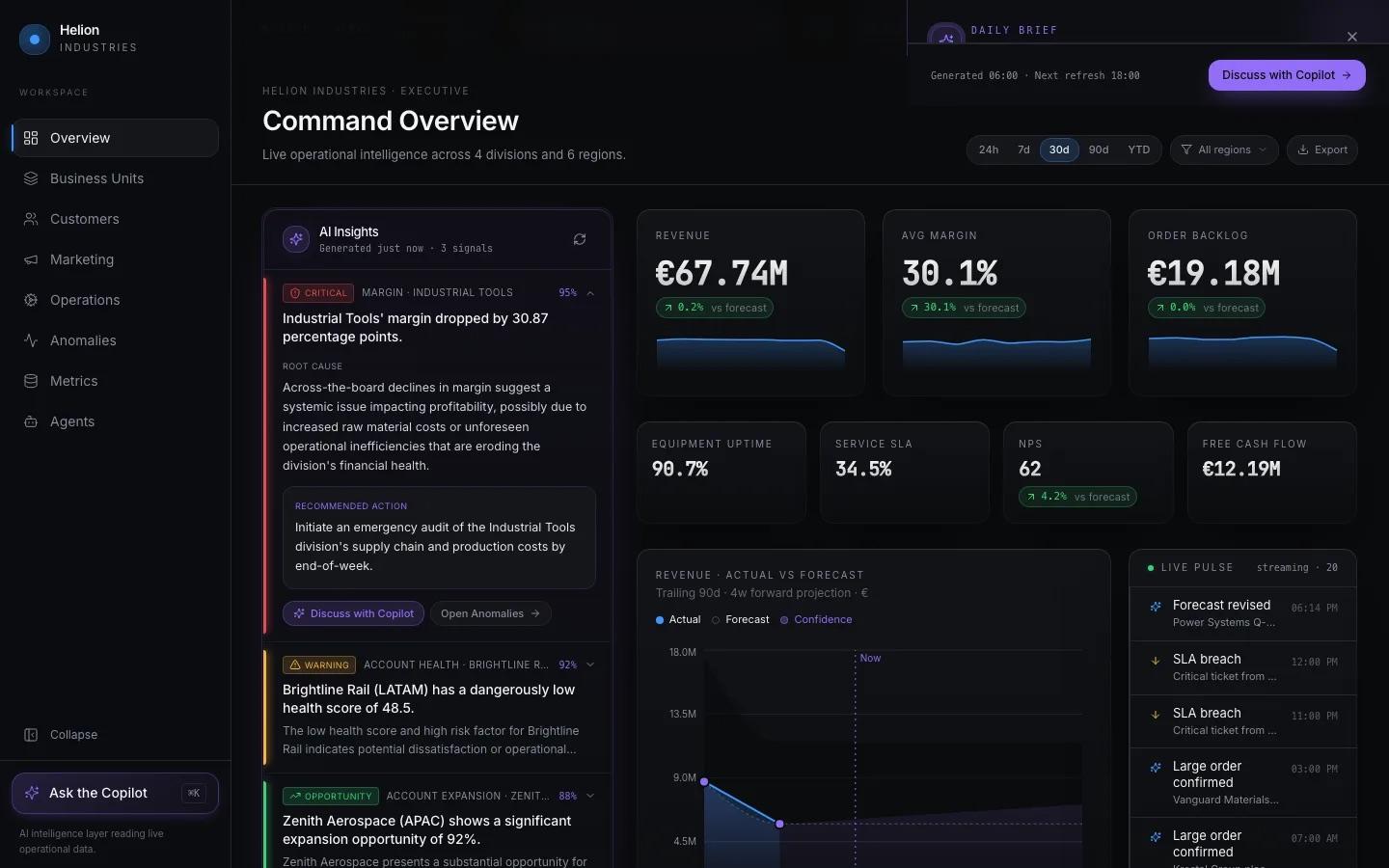
Apex Insight connects approved CRM, sales, marketing, pricing, finance, and operational signals so leaders can see what changed, investigate why, and decide what deserves action.
- For
- Leadership, revenue operations, sales, pricing, marketing, and finance
- Decision
- What changed, why does it matter, and what deserves review?
- Output
- Ranked signals, source-linked interpretation, and approval-aware actions
- Build status
- Capability lab using representative business data
One decision loop, with the evidence still attached.
Inspect a command workflow that keeps source metrics, interpretation, recommendation, and reviewer action together. Public business data and recommendations are illustrative.
Capability lab — representative business data and illustrative recommendations
Teams already have dashboards. What they lack is connected decisions.
CRM, analytics, pricing, finance, and operational tools can each be correct while leadership still spends the meeting reconciling what happened. A useful AI layer begins with one decision loop and keeps every recommendation tied to trusted source metrics.
Start with one governed decision loop.
- 01
Choose the decision
Begin with opportunity risk, pricing review, account expansion, or a performance deviation rather than every business signal at once.
- 02
Connect approved evidence
Bring together only the CRM, commercial, financial, and operational signals needed for that decision.
- 03
Keep reasoning inspectable
Show source, change, confidence, and material assumptions beside the recommendation.
- 04
Govern the next action
Define what stays advisory, what requires approval, and which low-risk task may be automated.
What this build demonstrates, and what a client-specific pilot would validate.
Review the capability, then define the data, controls, integrations, owners, and acceptance criteria for a bounded pilot.
- -Scattered reporting can become a focused, source-linked commercial decision loop.
- -Recommendations are more credible when the reviewer can inspect and challenge their evidence.
- -A useful pilot starts with one recurring decision and a small set of trusted signals.
Production use requires validated data quality, identity and access controls, source ownership, approval rules, monitoring, audit history, and a clear policy for which actions AI may suggest or execute.
- -A central dashboard layer that joins approved business signals from CRM, website, analytics, pricing, sales, and operations.
- -Role-specific views for leadership, revenue operations, sales, marketing, pricing, or delivery teams.
- -Governed recommendation and action flows, such as alerts, opportunity prioritization, pricing-review prompts, or CRM follow-up tasks.
Questions buyers may ask
Is Apex Insight just another BI dashboard?
No. The concept adds source-linked interpretation, prioritization, and approval-aware next actions above trusted metrics.
Can AI take actions automatically?
Only within a defined governance model. High-impact actions should remain advisory or require human approval; low-risk automation needs monitoring and audit history.
Where should a pilot begin?
With one recurring decision, a small number of reliable sources, a named owner, and a clear rule for what the system may recommend.
Start with one decision loop worth improving.
Choose the recurring commercial decision, connect only the evidence it needs, and define how people review and act on the result.