Make the DCS modernization path explicit before committing capital.
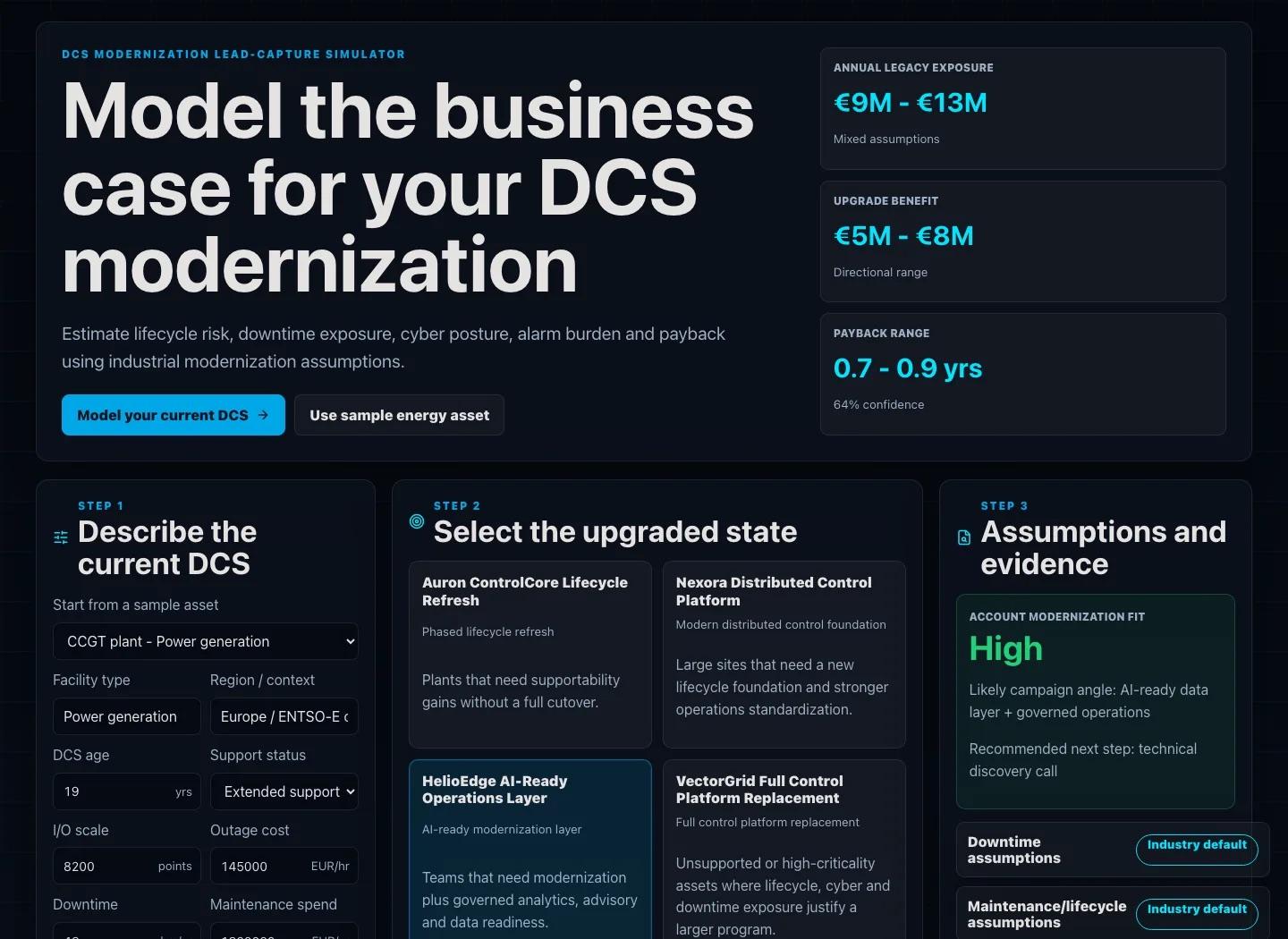
A guided decision model that connects lifecycle exposure, downtime risk, cyber posture, supportability, alarm burden, workforce constraints, and migration options into a reviewable modernization brief.
- For
- Plant leadership, automation, reliability, OT security, engineering, and finance
- Decision
- Phased refresh, platform modernization, AI-ready layer, or full replacement?
- Output
- Assumption-based option comparison and modernization discovery brief
- Build status
- Working reference build using a representative asset and illustrative ranges
Technical exposure and capital logic in one review.
Inspect a sample asset, compare modernization options, challenge the assumptions, and prepare a discovery brief. Financial ranges are illustrative, not measured outcomes.
Working reference build — representative asset and assumptions, not an engineering assessment or quote
Modernization stalls when technical risk and capital planning are handled separately.
A legacy control system can remain operational while supportability, outage exposure, cyber risk, alarm burden, workforce knowledge, and maintenance cost move in the wrong direction. Teams need one place to challenge those assumptions before selecting an upgrade path.
Turn plant context into an option discussion.
- 01
Describe current exposure
Capture DCS age, installed base, I/O scale, support status, outage exposure, alarm load, workforce risk, and OT maturity.
- 02
Compare modernization paths
Review phased lifecycle refresh, a modern DCS platform, an AI-ready operations layer, and full replacement.
- 03
Challenge the assumptions
Expose which inputs drive the range, where data is missing, and what needs engineering or financial review.
- 04
Prepare discovery
Create a brief that plant, engineering, commercial, and leadership teams can review together.
What this build demonstrates, and what a client-specific pilot would validate.
Review the capability, then define the data, controls, integrations, owners, and acceptance criteria for a bounded pilot.
- -A complex OT modernization topic can become a guided decision workflow instead of a static brochure.
- -Lifecycle, risk, migration, and business-case assumptions can be discussed in one place.
- -The workflow structures discovery while qualified owners retain engineering, cyber, and safety decisions.
Production use requires validated plant data, engineering ownership, OT security review, outage and cost assumptions, vendor-specific lifecycle evidence, and human approval.
- -A focused DCS modernization readiness simulator tailored to one industrial segment, vendor campaign, or modernization offer.
- -Scenario inputs for lifecycle exposure, downtime risk, support status, cyber posture, alarm burden, workforce risk, upgrade path, and payback assumptions.
- -CRM-ready business-case summaries and human review controls before using the output in sales or engineering decisions.
Questions buyers may ask
Is this an engineering assessment or migration plan?
No. It is a working reference build of a readiness workflow using a representative asset and illustrative assumptions.
Why use a guided modernization model?
It can bring lifecycle, downtime, cyber, supportability, migration, and capital assumptions into one structured discovery conversation.
What would production require?
Validated plant data, qualified engineering and OT-security review, current lifecycle evidence, approved cost assumptions, and a defined human-review process.
Create a modernization discussion engineering and finance can challenge together.
Start with one industrial segment, one modernization offer, and the assumptions that most often block a useful first conversation.