Compare grid-response scenarios before formal compliance review.
A browser-based decision tool for exploring AVR response, reactive power support, and transient stability so engineering and commercial teams can align on the questions that require formal verification.
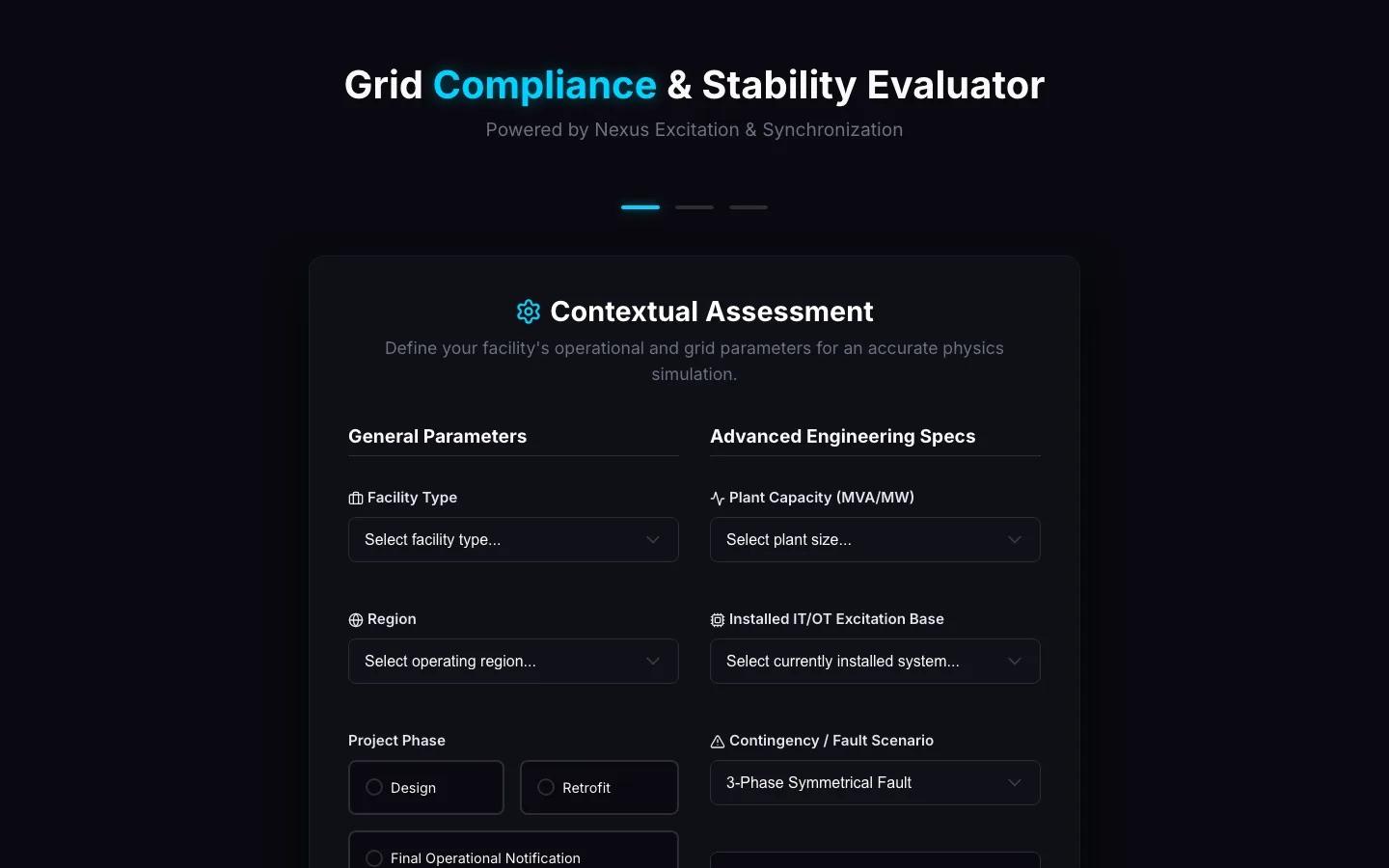
- For
- Grid-connection engineers, project developers, OEM technical sales, and compliance teams
- Decision
- Which operating and fault scenarios deserve deeper engineering study?
- Output
- Scenario comparison, assumptions, response curves, and review brief
- Build status
- Capability lab — formal verification remains required
Explore the scenarios that deserve formal engineering review.
Explore operating context, fault scenarios, response behavior, and review outputs. The simulator supports discussion before formal engineering and regulatory review.
Capability lab — not a certified compliance analysis or approval
Earlier scenario review can focus formal engineering on the right questions.
Formal grid-code compliance remains an engineering and regulatory process. A browser tool can still make early discussions more useful by exposing the assumptions, response behavior, and uncertainty that need qualified review.
From operating context to review brief.
- 01
Set the context
Define facility type, region, installed excitation base, plant capacity, project phase, and fault scenario.
- 02
Compare the response
Explore AVR response, reactive power support, recovery behavior, and stability margins under selected assumptions.
- 03
Expose uncertainty
Flag scenarios, missing data, and assumptions that require formal modelling or regulatory review.
- 04
Prepare the discussion
Create a shared brief for engineering, project, commercial, and compliance stakeholders.
What this build demonstrates, and what a client-specific pilot would validate.
Review the capability, then define the data, controls, integrations, owners, and acceptance criteria for a bounded pilot.
- -Browser-native simulation can make early power-system scenario discussions faster and easier to explain.
- -Inputs, response behavior, uncertainty, and formal-review boundaries can stay visible together.
- -The tool prepares qualified engineering work; it does not replace it.
Production use requires validated equipment models, applicable grid-code requirements, qualified engineering review, test evidence, and the relevant authority or system-operator process.
- -A web-based grid code compliance simulator with scenario inputs and visual outputs.
- -Digital twin-style views for excitation systems, AVR response, reactive power curves, and transient stability.
- -A compliance explanation layer for sales, engineering, and stakeholder review.
Questions buyers may ask
Is this a certified grid-compliance product?
No. It demonstrates an early scenario-review workflow and does not provide certification, regulatory approval, or an engineering guarantee.
What can the simulator support?
It can help teams compare selected scenarios, expose assumptions, and prepare a more useful discussion before formal modelling.
What would production require?
Validated models and plant data, applicable grid-code requirements, qualified engineering ownership, test evidence, and formal review.
Make early grid-response discussions more concrete.
Use a bounded simulator to identify the questions, assumptions, and scenarios that deserve formal engineering attention.