Compare carbon, cost, availability, and specification fit in one material decision.
A buyer-facing workbench for testing lower-carbon substitutions with commercial, regional, documentation, and certification tradeoffs visible.
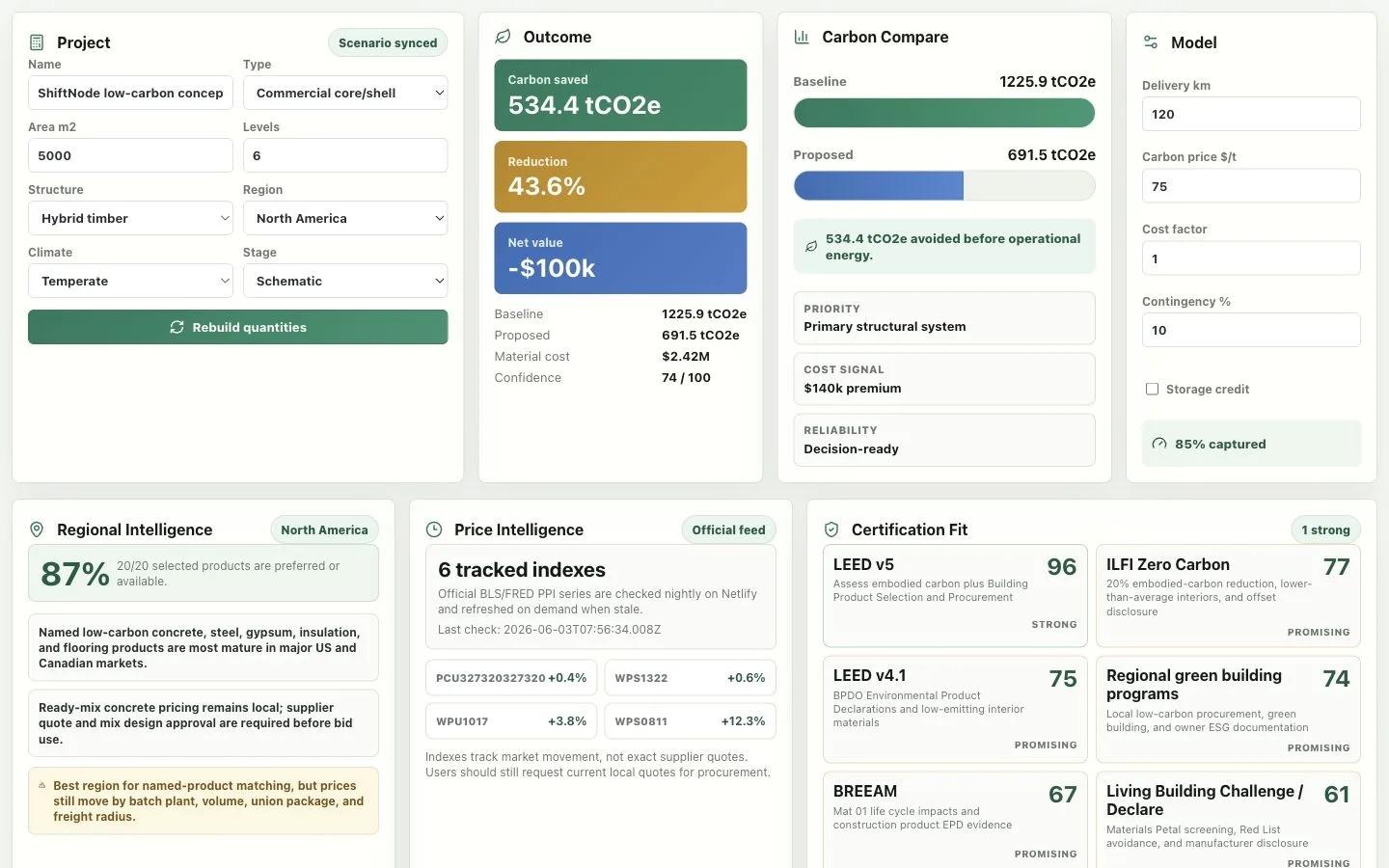
- For
- Material suppliers, sustainability teams, specifiers, contractors, and procurement
- Decision
- Which substitution is worth deeper commercial and technical assessment?
- Output
- Assumption-based carbon and cost comparison with evidence status
- Build status
- Working reference build — not a certified assessment or quote
A comparison built around the buyer's project.
Inspect the project assumptions, estimated carbon and cost difference, regional context, documentation status, and certification relevance in one workflow.
Working reference build — representative scenario data, not an LCA, EPD, assessment, or quote
A carbon claim is not yet a specification case.
Buyers need the project context, baseline, substitution, documentation, regional supply, price movement, and certification relevance behind the claim. Without that context, sustainability messaging remains difficult to use in a real procurement decision.
Build the comparison around the project.
- 01
Define the project
Set region, building type, area, structure, stage, transport, and commercial assumptions.
- 02
Compare the substitution
Model a baseline and proposed material mix using traceable product and EPD inputs.
- 03
Show evidence and uncertainty
Place estimated carbon and cost differences beside availability, documentation, and certification context.
- 04
Prepare the buyer brief
Make assumptions, sources, and evidence gaps visible for sales, sustainability, and procurement review.
What this build demonstrates, and what a client-specific pilot would validate.
Review the capability, then define the data, controls, integrations, owners, and acceptance criteria for a bounded pilot.
- -Product data, carbon evidence, cost signals, and specification context can become one buyer-facing decision workflow.
- -Commercial and sustainability tradeoffs can stay visible without overstating certification or precision.
- -A focused pilot can begin with one material family, market, and buyer decision.
A production version requires current EPDs, validated quantities and factors, regional product availability, dated price sources, qualified sustainability review, and clear uncertainty ranges.
- -A web-based material carbon lab with project assumptions, product substitutions, and editable model inputs.
- -Decision views for embodied carbon, cost signals, certification fit, regional availability, and product evidence.
- -A buyer-facing brief or export that supports specification conversations without replacing formal LCA, EPD, or procurement review.
Questions buyers may ask
Is this a certified LCA or EPD tool?
No. The public lab demonstrates a decision workflow and does not provide a certified LCA, EPD, certification assessment, or procurement quote.
What evidence matters in production?
Current EPDs, validated quantities and factors, product availability, dated price sources, certification requirements, and qualified review.
How should uncertainty be shown?
Inputs, source dates, assumptions, confidence, and missing evidence should remain visible beside the estimated outcome.
Turn a low-carbon claim into a reviewable buyer decision.
Build the evidence around the project, substitution, and commercial tradeoffs that determine whether a product can be specified.