Turn catalog complexity into a specification-ready sales brief.
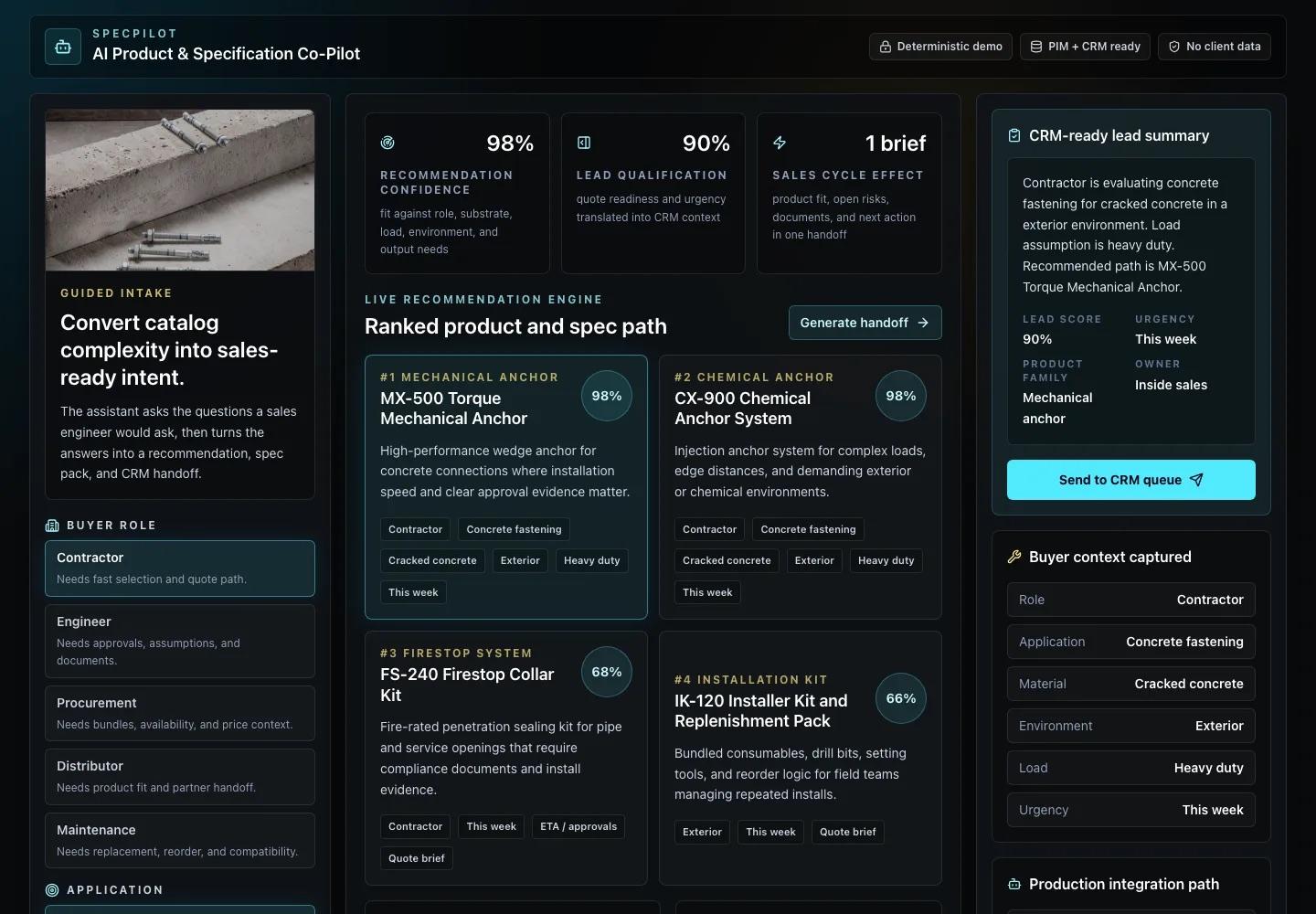
SpecPilot guides engineers, contractors, procurement teams, and distributors through the constraints that matter, ranks relevant products, explains tradeoffs, and gives sales the context to respond well.
- For
- Engineers, contractors, procurement, distributors, and technical sales
- Decision
- Which product best fits this application and its constraints?
- Output
- Ranked options, specification pack, and CRM-ready project brief
- Build status
- Working reference build using representative data
The guided workflow, available to inspect.
Move from buyer requirements to ranked product options, specification context, and a sales-ready handoff. The public build uses representative product and buyer data so the workflow can be examined safely.
Working reference build — representative catalog data and illustrative fit scores
Buyers struggle with navigation, not with the depth of the catalog.
Industrial buyers often know the application, environment, load, approvals, and timing they need. They do not always know the SKU. A static catalog makes them translate their requirement into the seller's internal structure before sales has learned anything useful.
From requirement to handoff in four moves.
- 01
Capture the requirement
Collect the buyer's role, application, substrate, environment, load, urgency, and documentation needs.
- 02
Apply approved fit rules
Use governed product data and selection logic to create a relevant shortlist.
- 03
Explain the tradeoffs
Show why each option fits, which evidence supports it, and where review is still needed.
- 04
Prepare the handoff
Generate a specification pack and project brief that sales can review before follow-up.
What this build demonstrates, and what a client-specific pilot would validate.
Review the capability, then define the data, controls, integrations, owners, and acceptance criteria for a bounded pilot.
- -A technical catalog can become a guided buyer journey while keeping engineering review explicit.
- -The buyer receives a clearer path while sales receives the assumptions, requirement, and next action.
- -A focused pilot can begin with one product family, buyer segment, or application workflow.
The public build uses representative products and illustrative confidence values. A production pilot connects approved PIM or catalog data, fit rules, current technical documents, CRM mapping, and human review for safety, regulatory, and engineering decisions.
- -A focused co-pilot pilot for one product family, buyer segment, or application workflow.
- -Grounded recommendations over approved product data, technical documents, fit rules, and commercial routing logic.
- -CRM-ready lead summaries, spec-pack generation, and human review controls before scaling.
Questions buyers may ask
Is SpecPilot a generic chatbot?
No. It behaves like a guided sales-engineering workflow: it captures structured buyer context, ranks options, explains tradeoffs, and prepares a handoff.
What data does the public build use?
It uses representative product and buyer data. A production pilot connects approved company data, rules, documents, and review controls.
What would production need?
Approved product data, fit rules, technical documents, CRM mapping, privacy controls, and a defined human-review boundary.
Make complex product knowledge easier to buy from.
Start with one product family and one high-friction buyer journey. Prove that better guidance produces a more useful commercial handoff before scaling.